You do not need a large lump sum to begin investing. In fact, the most important variable in long-term wealth building is not the size of your first deposit but the habit of investing consistently and keeping costs low. Thanks to fractional shares, low-cost index funds, and no-minimum brokerage accounts, a US investor can start with $5, $50, or $500 and still build a diversified portfolio. This guide explains the practical steps, the accounts to consider, and the mistakes that erode small portfolios.
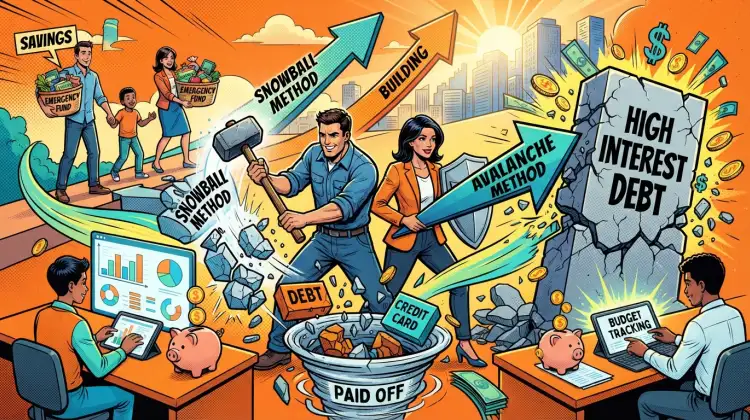
First, Put Your Financial Foundation in Place
Investing works best when it sits on top of a stable base. Before you buy a single share, take care of three things:
- An emergency fund. Aim for three to six months of essential expenses in a high-yield savings account. This prevents you from selling investments at a loss when an unexpected bill arrives.
- High-interest debt. Paying off a credit card with a 20%+ annual percentage rate is effectively a guaranteed return that no stock market can match. Prioritize that before investing beyond any employer retirement match.
- A realistic budget. Decide on a fixed monthly amount you can invest without touching it, even if that amount is $25.
If you have access to a workplace retirement plan such as a 401(k) with an employer match, contribute at least enough to capture the full match. That match is an immediate return on your contribution and is one of the few free lunches in personal finance.
Choose the Right Account for Your Goal
The account wrapper matters as much as the investment itself, because it determines your tax treatment.
Tax-advantaged retirement accounts
- Roth IRA: You contribute after-tax dollars, and qualified withdrawals in retirement are tax-free. For 2025, the contribution limit is $7,000 ($8,000 if you are 50 or older), subject to income phase-outs. A Roth IRA is often the best first account for a young or lower-income investor because the tax-free growth is valuable over decades.
- Traditional IRA: Contributions may be tax-deductible depending on your income and whether you have a workplace plan. Withdrawals are taxed as ordinary income in retirement.
- 401(k): Offered through employers, with higher limits ($23,500 in 2025, plus a $7,500 catch-up for those 50 and older) and often an employer match.
Taxable brokerage account
A regular brokerage account has no contribution limits and no withdrawal restrictions, which makes it suitable for goals before age 59½. You will owe capital gains tax on profits, but long-term gains (assets held over a year) are taxed at preferential rates.
Many brokerages now have no account minimums and no commissions on stock and ETF trades, so a small starting balance is not a barrier.
Use Fractional Shares and Low-Cost Funds
Two developments make small-scale investing genuinely practical today.
Fractional shares let you buy a slice of a stock or ETF rather than a whole share. If a single share of a broad-market ETF costs several hundred dollars, fractional investing lets you put in $10 and own a proportional piece. Many major US brokers offer this feature.
Low-cost index funds and ETFs give you instant diversification across hundreds or thousands of companies. A total stock market index fund or an S&P 500 index fund typically carries an expense ratio well under 0.10%. Compare that with actively managed funds that may charge 0.75% or more; over 30 years, a 1% difference in annual fees can consume a substantial portion of your returns.
A simple, low-cost approach for a beginner might be a single total-market index fund, or a target-date fund inside a retirement account that automatically adjusts its mix of stocks and bonds as you approach retirement.
Automate Small, Consistent Contributions
Dollar-cost averaging — investing a fixed amount on a regular schedule — removes the temptation to time the market. Set up an automatic transfer from your checking account to your brokerage or IRA on payday. Investing $50 every two weeks adds up to $1,300 a year, and at a hypothetical 7% average annual return, that grows to roughly $18,000 over 10 years and over $50,000 over 20 years. The exact figures depend on market performance, but the point is that modest, consistent amounts compound meaningfully.
Start with an amount you will not miss. Consistency matters more than the starting figure, and you can increase the automatic contribution whenever your income rises.
Watch the Costs That Hurt Small Portfolios Most
With a small balance, fees take a proportionally larger bite. Keep an eye on:
- Expense ratios: Favor index funds with ratios under 0.20%, ideally under 0.10%.
- Account fees: Many brokers have eliminated maintenance fees, but confirm before opening an account.
- Trading commissions and spreads: Commission-free trades are now standard at major brokers; avoid platforms that charge per-trade fees for small orders.
- Advisory fees: A robo-advisor charging 0.25% is reasonable; a human advisor charging 1% may not make sense until your portfolio is larger.
- Taxes: Hold investments for more than a year when possible to qualify for long-term capital gains rates, and use tax-advantaged accounts first.
Common Mistakes to Avoid
- Chasing hot stocks or meme investments with money you cannot afford to lose.
- Checking your balance daily and reacting to short-term volatility.
- Leaving cash sitting in a low-yield account instead of investing it for long-term goals.
- Ignoring the employer 401(k) match, which is effectively free money.
- Investing money you will need within two to three years; keep short-term savings in cash or a high-yield savings account.
What to Remember
Starting with little money is not a disadvantage — it is how most investors begin. Open a low-cost brokerage account or IRA, choose a broad index fund, and automate a small contribution every payday. Keep fees low, hold for the long term, and increase your contributions as your income grows. The math of compounding rewards time in the market far more than the size of your first deposit, so the best move is to start now with an amount you can sustain.