If you're carrying balances across credit cards, a car loan, and maybe a personal loan, the hardest part of getting out of debt usually isn't the math—it's deciding where to send extra money each month. The good news is that the core debt payoff strategies are simple, well documented, and flexible enough to fit almost any budget. This guide walks through the main approaches, how to choose one, and how to avoid the traps that keep balances hanging around for years.
Start With a Clear Inventory of What You Owe
Before you pick a strategy, list every debt with four details: the current balance, the interest rate (APR), the minimum monthly payment, and the due date. Include credit cards, student loans, auto loans, personal loans, and medical bills. Pull your free credit reports from AnnualCreditReport.com to make sure you haven't missed an account, and check each statement for the real APR—promotional rates can expire and jump significantly.
This inventory does two things. First, it shows your total minimum payments, which tells you how much room you have to add extra. Second, it reveals the interest rates, which is the single most important number for prioritizing debt. According to the Federal Reserve, credit card APRs for accounts assessed interest have hovered well above 20% in recent years, while many auto and personal loans sit in the single digits or low teens. That gap is what makes payoff order matter.
The Avalanche Method: Minimize Interest Paid
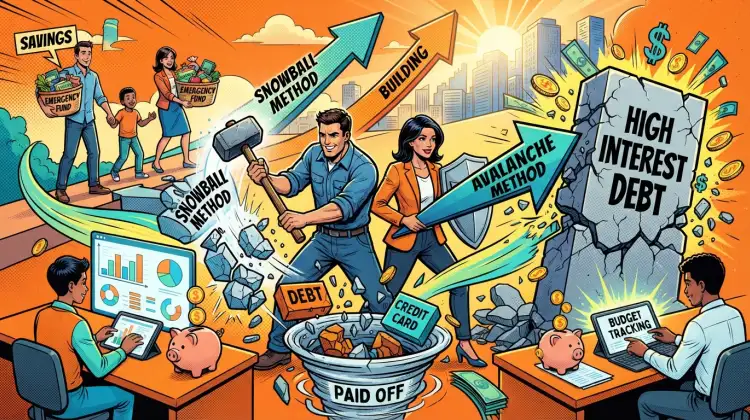
With the debt avalanche, you make minimum payments on everything and throw every extra dollar at the debt with the highest interest rate. When that balance is gone, you roll its payment into the next-highest-rate debt, and so on.
- Best for: People motivated by numbers who want to pay the least total interest.
- Strength: Mathematically efficient—high-rate credit card debt disappears first.
- Weakness: If your biggest balance also has the highest rate, it can take months before you see an account close, which some people find discouraging.
Example: Suppose you have a $6,000 credit card at 24% APR, a $9,000 personal loan at 11%, and a $12,000 auto loan at 6%. Under the avalanche, the credit card gets all extra money first. Clearing it removes the most expensive interest and frees up cash flow fastest in dollar terms.
The Snowball Method: Build Momentum With Quick Wins
The debt snowball flips the priority: you pay minimums on everything and attack the smallest balance first, regardless of interest rate. Once it's paid off, you roll that payment into the next-smallest balance.
- Best for: People who need visible progress to stay motivated.
- Strength: Early wins create momentum and reduce the number of accounts you're managing.
- Weakness: You may pay more total interest than with the avalanche if your smallest debts carry low rates.
Research on consumer behavior has found that closing accounts—even small ones—can increase persistence in debt repayment, which is why the snowball resonates with many households. The best method is the one you'll actually follow for 12 to 36 months.
Hybrid and Support Strategies Worth Pairing With Either Method
Balance transfers and refinancing
A 0% APR balance transfer card can pause interest on credit card debt for a promotional period, typically 12 to 21 months, though you'll usually pay a 3% to 5% transfer fee. Do the math: if the fee is less than the interest you'd otherwise pay, it can accelerate payoff. Similarly, refinancing a personal loan or auto loan at a lower rate can shrink the total cost—but watch for extended terms that lower the payment while increasing total interest.
Debt consolidation loans
A consolidation loan replaces multiple balances with one fixed payment. It simplifies budgeting, but it only helps if you stop adding new balances to the cards you've paid off. Otherwise you've simply moved the debt and kept the spending habit.
Debt management plans
Nonprofit credit counseling agencies can set up a debt management plan that negotiates lower interest rates with creditors and consolidates payments into one monthly amount. These are legitimate services, but verify the agency's nonprofit status and avoid any organization charging large upfront fees.
Protect the essentials first
Before aggressively paying debt, build a small emergency fund—even $500 to $1,000—so an unexpected car repair doesn't send you back to credit cards. Contribute at least enough to your workplace retirement plan to capture any employer match; that's an immediate return you can't replicate by prepaying a 7% loan.
How to Choose and Execute Your Plan
- Run both scenarios. Use a free debt payoff calculator to compare total interest and payoff dates under avalanche and snowball. If the difference is small, pick the one that keeps you motivated.
- Automate minimums. Set autopay for every minimum payment to avoid late fees and penalty APRs.
- Schedule the extra payment. Send your extra amount on the same day each month, ideally right after payday.
- Review quarterly. Reassess rates, balances, and whether a balance transfer or refinance makes sense.
- Redirect freed-up payments. When a debt is paid off, immediately apply that payment to the next target rather than absorbing it into spending.
Also check your credit reports annually for errors and consider a credit score monitoring tool. A higher score can unlock better refinancing rates, which compounds your progress.
The Short Version
Debt payoff strategies come down to two proven paths—avalanche for the lowest total interest, snowball for the strongest momentum—plus tools like balance transfers, refinancing, and credit counseling that can speed either one up. Inventory every balance and rate, automate minimums, protect a small emergency fund, and redirect each paid-off payment to the next debt. The method matters less than consistency: a modest extra payment applied every month for a few years will outperform an aggressive plan you abandon after two months.