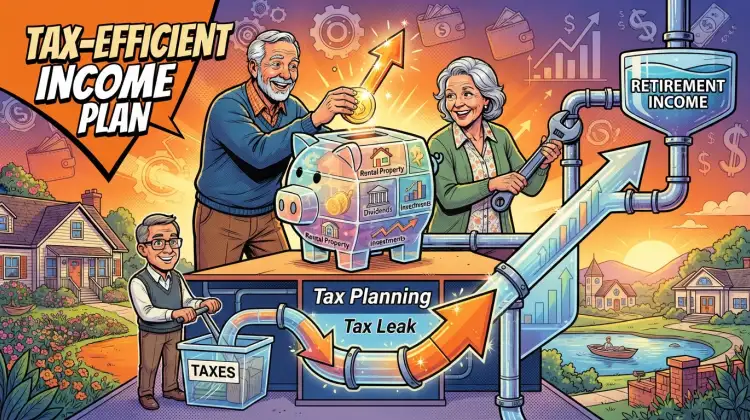
Retirement income planning is less about how much you have saved and more about how you sequence withdrawals from different accounts. Each income source carries its own tax treatment, timing rules, and risk profile. Understanding how Social Security, traditional retirement accounts, Roth accounts, pensions, and taxable savings interact can meaningfully affect how long your money lasts and how much of it you keep after taxes.
This guide walks through the major retirement income sources available to most US households and explains how to combine them into a coherent, tax-aware strategy.
Social Security: The Foundation of Most Retirement Plans
Social Security is the largest single source of retirement income for most American retirees. According to the Social Security Administration, benefits replace about 40% of pre-retirement earnings for a typical medium earner, though that figure varies widely by income level.
Two planning levers matter most:
- Claiming age. Full retirement age is 67 for anyone born in 1960 or later. Claiming at 62 permanently reduces benefits by up to 30%, while delaying to age 70 increases them by 8% per year beyond full retirement age.
- Taxation of benefits. Up to 85% of benefits can be subject to federal income tax depending on your "combined income" (adjusted gross income plus tax-exempt interest plus half of your benefits). Several states also tax benefits; many do not.
Because provisional income thresholds are not indexed for inflation, more retirees owe tax on benefits each year. Coordinating Roth conversions or capital gains in low-income years before claiming can reduce that exposure.
Traditional 401(k)s and IRAs: Tax-Deferred but Taxed Later
Withdrawals from traditional 401(k)s, 403(b)s, and traditional IRAs are taxed as ordinary income. Ordinary income tax rates currently top out at 37%, and the Tax Cuts and Jobs Act brackets are scheduled to revert to higher pre-2018 rates after 2025 unless Congress acts.
Key rules to build into your plan:
- Required minimum distributions (RMDs). Under SECURE 2.0, the RMD age is 73 for those born 1951–1959 and 75 for those born in 1960 or later. Missing an RMD triggers a 25% excise tax, reduced to 10% if corrected promptly.
- Roth conversions. Converting traditional balances to Roth in lower-income years can shrink future RMDs and reduce lifetime taxes, but conversions are taxable in the year made and can push you into a higher bracket or increase Medicare premiums.
- Qualified charitable distributions. From age 70½, you can send up to $105,000 per year (2024, indexed) directly from an IRA to charity, satisfying RMDs without adding to taxable income.
Roth Accounts and Taxable Brokerage: Flexible, Low-Tax Income
Roth IRA and Roth 401(k) qualified withdrawals are tax-free and do not count toward provisional income for Social Security taxation. Roth accounts have no RMDs during the owner's lifetime, making them valuable for late-life flexibility and for heirs under the 10-year distribution rule for inherited accounts.
Taxable brokerage accounts offer another layer of control. Long-term capital gains and qualified dividends are taxed at 0%, 15%, or 20% depending on income, and the 0% bracket is often available in early retirement before Social Security and RMDs begin. Tax-loss harvesting and holding assets over one year help keep this income source efficient.
Pensions, Annuities, and Part-Time Work
Traditional defined-benefit pensions are increasingly rare in the private sector but remain common for public employees. Pension income is generally taxed as ordinary income at the federal level, though contributions made with after-tax dollars may be partially excluded.
Annuities can convert savings into guaranteed lifetime income, but be aware that gains in non-qualified annuities are taxed as ordinary income, and early withdrawals may trigger surrender charges. Meanwhile, earned income from part-time or consulting work can bridge the gap before Social Security and may allow continued contributions to an IRA or employer plan, provided you have earned income.
Sequencing Your Retirement Income Sources
A common approach is a "tax-bracket filling" strategy: draw from taxable accounts first to keep taxable income low, use Roth conversions in the gap years before Social Security and RMDs, then layer in traditional withdrawals and Social Security. Others prefer proportional withdrawals from all accounts to smooth taxes over time.
Whichever method you choose, model the interaction of federal brackets, state taxes, Medicare IRMAA surcharges, and Social Security taxation. A one-time projection often reveals that a modest Roth conversion in your early 60s saves more than a decade of higher RMDs later.
What to Remember
Your retirement income is a portfolio of tax treatments, not just a pile of money. Social Security timing, RMD rules, Roth flexibility, and capital gains brackets all interact. Review your withdrawal order annually, especially in the years between retirement and age 73, when you have the most control over taxable income. A coordinated plan can lower lifetime taxes and extend the life of your savings.