Investing for beginners can feel intimidating, but the core idea is simple: you buy a small ownership stake in companies or lend money to institutions, and over time those assets can grow in value and generate income. The U.S. offers a wide range of regulated, low-cost ways to do this, from index funds inside a brokerage account to a 401(k) through your employer. This guide explains the mechanics, the accounts, and the habits that separate patient investors from people who lose money chasing hot tips.
Why investing matters more than saving alone
Cash in a savings account is safe, but it typically earns less than inflation over long periods. According to the Federal Reserve, the long-run average annual return on the S&P 500 has historically outpaced the interest paid on savings deposits by a wide margin, though past performance never guarantees future results. The point is not that stocks always go up — they don't — but that owning productive assets has historically been one of the more reliable ways to preserve and grow purchasing power over decades.
The other force working in your favor is compounding. A $5,000 investment earning 7% annually grows to roughly $19,000 in 20 years without any additional contributions. Add $200 a month and the balance climbs to about $125,000. Time in the market matters more than the size of your first deposit.
The main asset classes explained
- Stocks (equities): Shares of ownership in a company. They offer the highest long-term growth potential but can fall sharply in the short term.
- Mutual funds and ETFs: Baskets of many stocks or bonds. Index funds track a market benchmark like the S&P 500 or the total U.S. stock market at very low cost.
- Bonds: Loans to the U.S. government, municipalities, or corporations. They generally provide steadier income and lower volatility than stocks.
- Cash equivalents: Money market funds and Treasury bills. Useful for short-term goals and emergency reserves, not long-term growth.
Most beginners are best served by a diversified index fund rather than individual stocks. A single fund can hold thousands of companies, which reduces the risk that one bad earnings report wipes out your savings.
Choose the right account first
Before picking investments, pick the container. In the U.S., the tax treatment of an account often matters as much as what you hold inside it.
401(k) and employer plans
If your employer offers a 401(k), contribute at least enough to capture the full company match. A 50% match on the first 6% of salary is effectively an immediate 50% return on that portion. In 2025, the IRS allows employees to contribute up to $23,500 to a 401(k), with a higher catch-up limit for those 50 and older.
Individual Retirement Accounts (IRAs)
A traditional IRA gives you a tax deduction now and taxes withdrawals later; a Roth IRA uses after-tax money and lets qualified withdrawals come out tax-free. The 2025 IRA contribution limit is $7,000, plus a $1,000 catch-up for people 50 and older. Roth IRAs are especially attractive for beginners early in their careers when their tax bracket is lower.
Taxable brokerage accounts
Once tax-advantaged accounts are funded, a regular brokerage account offers unlimited contributions and full flexibility. You'll owe capital gains tax on profits, but long-term gains (assets held over a year) are taxed at preferential rates.
How to start with a small amount
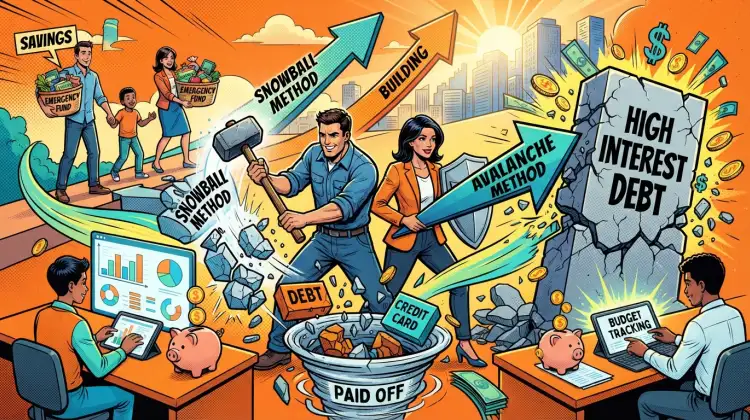
- Build an emergency fund first. Keep three to six months of expenses in a high-yield savings account so you never have to sell investments at a loss to cover a surprise bill.
- Pay down high-interest debt. No realistic investment reliably beats the 20%+ interest on a credit card balance.
- Open an account. Most major brokerages now charge $0 commissions on stock and ETF trades, and many have no account minimums.
- Buy a broad index fund. A total market or S&P 500 ETF is a common starting point. Consider automatic monthly contributions so you invest consistently regardless of headlines.
- Leave it alone. Check your balance quarterly, not daily. Selling during a downturn locks in losses.
Common beginner mistakes to avoid
Chasing meme stocks, trading on social media tips, and paying high advisory fees are the fastest ways to underperform. The SEC has repeatedly warned about the risks of unregistered investment schemes and guaranteed-return pitches. Also beware of concentration: putting your entire portfolio into your employer's stock or a single sector exposes you to risks that diversification is designed to reduce. Finally, watch fees — a 1% annual expense ratio may sound small, but over 30 years it can consume a meaningful share of your returns.
Building a simple long-term plan
A workable beginner portfolio might look like this: an emergency fund in cash, a 401(k) invested in a target-date fund or low-cost index fund, a Roth IRA holding a total market ETF, and a taxable account for extra savings. Review your allocation once a year, rebalance if it drifts, and increase contributions whenever your income rises. The goal is a system you can maintain for decades, not a clever trade you make this week.
What to Remember
Investing rewards patience and consistency far more than cleverness. Start with an emergency fund, capture your full employer match, choose low-cost diversified funds, and let compounding do the heavy lifting. Keep fees low, ignore hype, and treat market downturns as normal rather than catastrophic. If you want personalized tax or allocation advice, a fee-only fiduciary advisor can help — but for most beginners, a simple index-fund approach inside a tax-advantaged account is a strong foundation.