When a large expense lands — a medical bill, a home repair, a debt consolidation plan — the two most common borrowing tools for US consumers are a personal loan and a credit card. Both give you access to money you don't have on hand, but they work very differently in how interest accrues, how repayment is structured, and how they affect your credit. Choosing the wrong one can cost hundreds or thousands of dollars in unnecessary interest. This guide breaks down the mechanics of each so you can match the product to the purpose.
How a Personal Loan Works
A personal loan is an installment loan: you borrow a lump sum from a bank, credit union, or online lender and repay it in fixed monthly payments over a set term, typically 12 to 84 months. Most personal loans are unsecured, meaning they aren't backed by collateral like a car or house. Because the loan has a defined term and fixed interest rate, your payment is predictable from day one.
Interest rates on personal loans vary widely by credit profile. According to Federal Reserve data, the average rate on a 24-month personal loan at commercial banks has hovered in the low double digits in recent years, but borrowers with excellent credit often qualify for single-digit rates while those with poor credit may see rates above 20%. Lenders also charge origination fees, commonly 1% to 8% of the loan amount, which are often deducted from the proceeds.
- Fixed payments: The same amount is due each month, making budgeting straightforward.
- Defined payoff date: You know exactly when the debt ends.
- Lump sum: Ideal for a one-time expense you can't easily split across months.
- Potential lower rate: For borrowers with good credit, personal loan rates are frequently lower than credit card APRs.
How a Credit Card Works
A credit card is a revolving line of credit. You can spend up to your credit limit, repay some or all of the balance, and then borrow again as you pay it down. If you pay the statement balance in full each month, you owe no interest — a grace period typically applies to new purchases. If you carry a balance, interest accrues daily on the remaining amount.
Credit card interest rates are among the highest of any consumer borrowing product. The Federal Reserve reports that average credit card APRs have been above 20% in recent years, and store-branded cards can run even higher. That makes credit cards an expensive way to finance a balance over many months, even though they're convenient and offer rewards and purchase protections.
- Revolving credit: Reuse the limit as you repay.
- Grace period: No interest if you pay in full each month.
- Variable APR: Rates can rise or fall with the prime rate.
- Minimum payments: Paying only the minimum stretches repayment over years and maximizes interest.
Side-by-Side Comparison
The right choice depends on the size of the expense, how long you'll need to repay, and your credit profile. Here's how the two products stack up on the factors that matter most.
- Interest rate: Personal loans usually win for borrowers with fair-to-good credit; credit cards are typically the most expensive option when carrying a balance.
- Repayment structure: Personal loans offer fixed payments and a firm payoff date; credit cards offer flexibility but encourage slow repayment.
- Fees: Personal loans may charge origination fees; credit cards may charge annual fees, late fees, and balance transfer fees.
- Credit impact: A personal loan adds a new installment account and a hard inquiry; a new credit card adds a hard inquiry and lowers your average account age, but also increases available credit, which can help your utilization ratio.
- Best use case: Personal loans suit large one-time expenses and debt consolidation; credit cards suit short-term purchases you can pay off within a statement cycle.
When a Personal Loan Makes More Sense
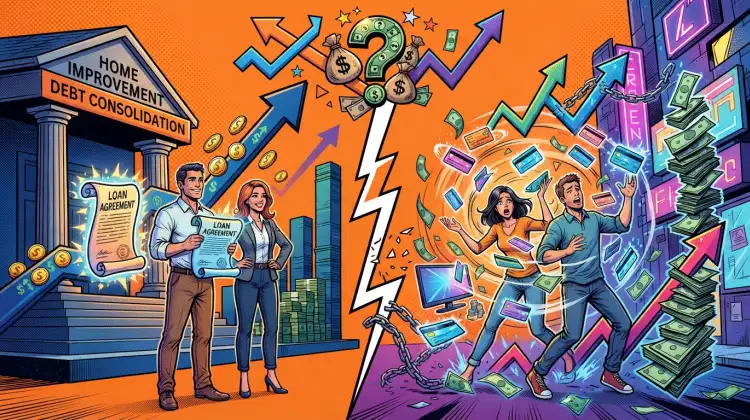
If you're facing a sizable expense — say $5,000 for a roof repair or a medical procedure — and you'll need more than a few months to pay it off, a personal loan is often the cheaper route. Fixed rates and a set term prevent the balance from lingering indefinitely. Personal loans are also a common tool for consolidating high-interest credit card debt: you replace several variable-rate balances with one fixed-rate payment, which can lower your overall interest cost and simplify your finances.
One caveat: consolidation only works if you stop adding new credit card debt. Otherwise you end up with a loan payment plus fresh balances.
When a Credit Card Makes More Sense
For smaller purchases you can repay within a month or two, a credit card is hard to beat. You get an interest-free grace period, fraud protection under federal law, and potentially rewards. Credit cards also offer flexibility that installment loans lack — you can pay more in a strong month and less in a tight one, though carrying a balance triggers interest.
A 0% introductory APR offer on purchases or balance transfers can be a low-cost bridge if you can clear the balance before the promotional period ends. Miss that deadline, though, and the standard APR — often above 20% — applies to the remaining balance.
Watch the Costs That Don't Show Up in the Rate
Compare the annual percentage rate, not just the interest rate, since APR includes fees. On a personal loan, ask whether the origination fee is deducted from proceeds and how that affects the amount you actually receive. On a credit card, check the penalty APR, cash advance fees (cash advances typically start accruing interest immediately with no grace period), and foreign transaction fees if you'll spend abroad. Run the total cost of each option over your expected repayment period before deciding.
What to Remember
Personal loans and credit cards solve different problems. Use a personal loan when you need a lump sum, want a fixed payment, and can qualify for a rate meaningfully below what a card would charge. Use a credit card for convenience and short-term spending you can pay off before interest kicks in. In both cases, borrow only what you can repay, check your credit score first to anticipate the rate you'll be offered, and compare at least three offers before signing. The cheapest borrowing option is the one whose total cost — interest plus fees — you can comfortably afford to repay on schedule.