When you borrow money, the interest rate is the price you pay for using someone else's funds. It determines how much a loan actually costs over its life, and small differences in rate can translate into thousands of dollars. Understanding interest rates on loans means looking past the headline number and knowing how rates are calculated, how they're quoted, and which type fits your situation. This guide explains the mechanics in plain terms so you can compare offers with confidence.
What an Interest Rate Actually Is
An interest rate is a percentage charged on the principal balance of a loan, expressed on an annual basis. If you borrow $10,000 at 8% simple interest for one year, you pay $800 in interest. That basic math gets more complicated depending on how the lender calculates and applies interest.
Lenders set rates based on several factors: the Federal Reserve's benchmark rate, their own cost of funds, your credit score and credit history, the loan term, whether the loan is secured by collateral, and the lender's assessment of default risk. Borrowers with higher credit scores and lower debt-to-income ratios generally qualify for lower rates. The Federal Reserve publishes current rate data through its consumer credit statistics, which is a useful baseline for judging whether an offer is competitive.
Interest Rate vs. APR: The Number That Matters
The interest rate is only part of your cost. The annual percentage rate (APR) is a broader measure that includes the interest rate plus certain fees, such as origination charges, and expresses the total cost of borrowing as a yearly percentage. Under the Truth in Lending Act, lenders must disclose the APR on most consumer loans, which makes it easier to compare offers.
- Interest rate: the cost of borrowing the principal, used to calculate your monthly payment.
- APR: the interest rate plus qualifying fees, giving a more complete picture of cost.
- When to use APR: comparing loans with different fee structures or terms.
- When the interest rate matters more: if you plan to pay the loan off early, since upfront fees in the APR are paid regardless.
A loan with a lower interest rate but steep fees can cost more than one with a slightly higher rate and no fees. Always compare APRs, then check the fee schedule.
Fixed vs. Variable Rates
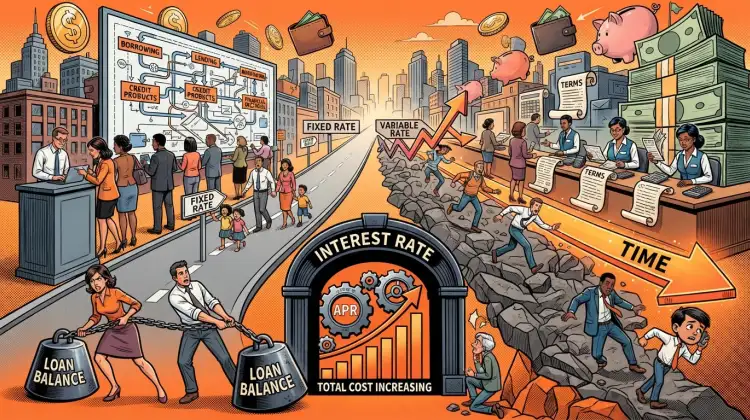
A fixed rate stays the same for the life of the loan, so your monthly payment is predictable. Fixed rates are common on auto loans, personal loans, and most mortgages. They protect you from rising rates but usually start higher than variable rates because the lender bears the risk of rate changes.
A variable rate, also called an adjustable rate, can change based on a benchmark index plus a margin set by the lender. Home equity lines of credit and some adjustable-rate mortgages use this structure. The initial rate may be lower, but payments can rise if the index increases. Most variable-rate loans include caps that limit how much the rate can increase per adjustment period and over the loan's life. If your budget can't absorb a higher payment, a fixed rate is the safer choice.
Simple vs. Compound Interest and How Payments Are Applied
Most installment loans, including auto and personal loans, use simple interest calculated on the outstanding principal. Interest accrues daily or monthly, and each payment first covers accrued interest, then reduces principal. This is why paying extra toward principal early saves more money: it shrinks the balance on which future interest is charged.
Credit cards and some other revolving products use compound interest, meaning interest can be charged on unpaid interest as well as principal. That's one reason revolving balances grow quickly when left unpaid. Student loans may use either structure depending on the loan type.
Loan amortization also matters. A 30-year mortgage spreads principal repayment over 360 payments, so early payments are mostly interest. A shorter term means higher monthly payments but far less total interest. For example, a $250,000 mortgage at 6% costs roughly $289,000 in interest over 30 years but about $93,000 over 15 years, based on standard amortization.
How to Compare Loan Offers and Lower Your Rate
Comparing offers side by side is the most reliable way to reduce borrowing costs. Follow these steps:
- Gather at least three offers from different lenders, including banks, credit unions, and online lenders.
- Compare APRs, not just interest rates, and review all fees in the loan estimate or disclosure.
- Check the term length. A longer term lowers the monthly payment but increases total interest.
- Ask about rate discounts, such as autopay discounts or relationship pricing.
- Improve your credit profile before applying by paying down balances and correcting errors on your credit reports.
Also watch for prepayment penalties, which charge a fee if you pay off the loan early, and confirm whether the rate is fixed or variable. For mortgages, compare loan estimates using the APR and the total interest percentage shown on the form.
What to Remember About Loan Interest Rates
The interest rate is the core cost of borrowing, but the APR gives you the fuller picture once fees are included. Fixed rates offer predictability; variable rates offer a lower starting cost with more risk. Simple interest rewards early principal payments, while compound interest on revolving balances can escalate quickly. Before signing, compare multiple offers, read the fee schedule, and confirm the term and rate type. A few hours of comparison shopping can save you far more than any negotiation tactic.