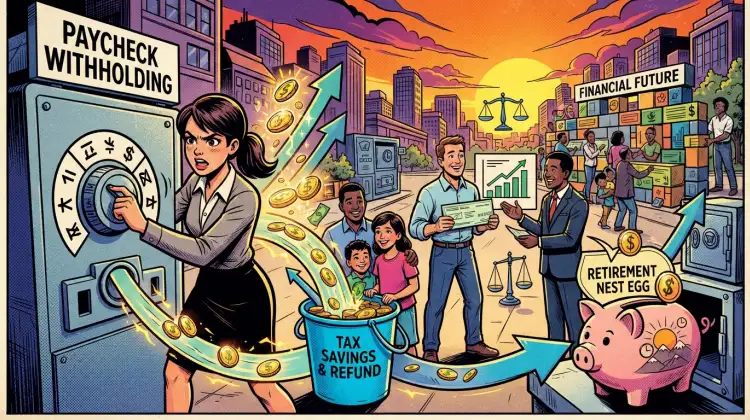
If you have ever received a tax refund and treated it like a windfall, you are not alone. But a refund is not free money — it is your own money coming back to you because too much was withheld from your paychecks during the year. Understanding the relationship between withholding and tax refunds helps you keep more cash in your pocket throughout the year and avoid unpleasant surprises in April. This guide explains how federal income tax withholding works, why refunds happen, and how to fine-tune your paycheck using the IRS Form W-4.
What Is Federal Income Tax Withholding?
The U.S. income tax system is pay-as-you-go. Rather than waiting until you file your return to collect tax, the IRS requires employers to withhold federal income tax from each paycheck and send it to the government on your behalf. Your employer calculates the amount using the information you provide on Form W-4, Employee's Withholding Certificate, along with IRS Publication 15-T withholding tables.
Withholding is not the only amount taken from your pay. Your paycheck also shows Social Security and Medicare taxes (FICA), which are calculated at fixed rates — 6.2% and 1.45% respectively for employees — and are not affected by your W-4. Only federal income tax withholding is adjustable through your W-4 elections.
If you are self-employed or receive income not subject to withholding, you generally make estimated tax payments quarterly using Form 1040-ES. The same pay-as-you-go principle applies.
Why You Get a Tax Refund (and Why It Isn't a Bonus)
A tax refund happens when the total tax withheld from your pay during the year exceeds your actual tax liability. In effect, you overpaid and the IRS is returning the difference. Common reasons for overwithholding include:
- Claiming the standard withholding on your W-4 without accounting for deductions, credits, or a spouse's income
- Holding multiple jobs and each employer withholding as if it were your only job
- Qualifying for refundable credits such as the Earned Income Tax Credit or the Child Tax Credit
- Experiencing a mid-year change such as a job loss, marriage, or a new dependent
A large refund means you gave the government an interest-free loan for the year. That is not inherently bad — some people prefer the forced savings — but it is a choice worth making deliberately. The IRS's own guidance notes that you can adjust withholding at any time by submitting a new W-4 to your employer.
How to Adjust Your Withholding Using Form W-4
Since 2020, the W-4 no longer uses withholding allowances. Instead, it relies on a five-step worksheet that lets you enter dollar amounts for dependents, other income, deductions, and extra withholding. Here is how to approach it:
- Step 1: Enter your personal information and filing status. Note that checking the box for multiple jobs or a working spouse changes the calculation.
- Step 2: If you hold more than one job or are married filing jointly with two incomes, complete the Multiple Jobs Worksheet or use the IRS Tax Withholding Estimator.
- Step 3: Claim dependents. The Child Tax Credit and Credit for Other Dependents can be reflected here to reduce withholding.
- Step 4: Add other income (interest, dividends, side gigs) or deductions (itemized deductions, IRA contributions, student loan interest) so withholding matches your actual tax picture.
- Step 5: Sign and submit. You can also request an extra flat dollar amount per paycheck if you want a buffer against underpayment.
The IRS Tax Withholding Estimator is a free tool that walks you through these inputs and tells you whether to expect a refund or a balance due. Running it after any major life change is a sensible habit.
Underwithholding: Penalties and How to Avoid Them
Underwithholding is the flip side of a refund. If you pay too little during the year, you may owe a balance when you file — and potentially an underpayment penalty. The IRS generally requires you to pay at least 90% of your current-year tax or 100% of your prior-year tax (110% if your prior-year adjusted gross income exceeded $150,000) to avoid the penalty.
To stay safe, consider these steps:
- Recheck your W-4 whenever you change jobs, marry, divorce, have a child, or start a side business
- If you have significant investment or freelance income, make quarterly estimated payments
- Use the safe harbor rules above to protect against penalties even if your income rises
- Keep an eye on your year-to-date withholding in each pay stub
Retirees should also review withholding on Social Security benefits, pensions, and IRA distributions using Form W-4V or Form W-4R, since these income streams can create unexpected tax liability.
Withholding, Refunds, and Long-Term Tax Planning
Withholding is not just an administrative detail — it is a lever for tax planning. Getting your withholding close to your actual liability frees up cash flow during the year that you can direct toward retirement accounts, an emergency fund, or debt payoff. If you prefer a refund as a savings mechanism, that is a legitimate choice, but recognize the trade-off: you could instead set up automatic transfers to a high-yield savings account and earn interest on the same money.
For higher earners, coordinating withholding with contributions to a 401(k), traditional IRA, or health savings account can lower taxable income and reduce the amount that needs to be withheld. Reviewing your W-4 alongside your retirement contributions each fall — before year-end — gives you time to make adjustments that affect the current tax year.
The Short Version
Withholding is the pay-as-you-go mechanism that collects federal income tax from your paycheck, and a refund is simply the return of any overpayment. You control the outcome through Form W-4: claim dependents and deductions to reduce withholding, add extra withholding if you have other income, and use the IRS Tax Withholding Estimator to check your settings. Aim to match withholding to your actual liability so you neither overpay throughout the year nor face a penalty in April. Revisit your W-4 after any major life or income change, and treat your refund — if you get one — as a deliberate planning outcome rather than a surprise.