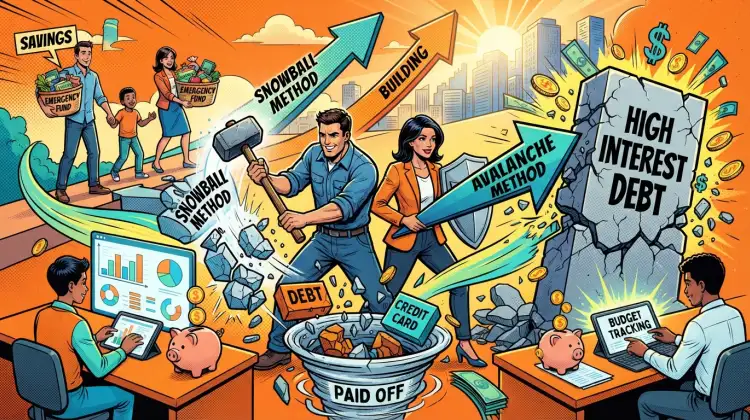
A monthly budget is simply a plan for where your money goes before the month begins. Done well, it turns vague financial stress into a set of concrete decisions: how much goes to rent, groceries, debt payments, and savings, and what is left for everything else. The process takes about an hour the first time and far less once you have a system in place. Here is how to build a monthly budget that reflects real life in the United States, using the accounts and tools most households already have.
Step 1: Add Up Your Take-Home Income
Start with what actually lands in your checking account, not your gross salary. If you are a salaried employee, use your net pay after federal income tax, FICA (Social Security and Medicare), and any pre-tax deductions such as a 401(k) contribution or health insurance premium. If your income varies — hourly work, gig income, commissions, or self-employment — budget from a conservative baseline. A common approach is to average your lowest three months rather than your best one, then treat any extra income as a bonus you can direct toward savings or debt.
Include every recurring inflow: paychecks, side work, child support received, and any predictable benefits. If you are married or share expenses with a partner, decide up front whether you are budgeting jointly, separately, or with a hybrid model, and make sure both people can see the same numbers.
Step 2: Track Your Actual Spending for One Month
You cannot budget accurately against guesses. Pull the last 30 to 60 days of transactions from your checking account, credit cards, and any payment apps you use, and group them into categories. Most banks and credit unions now categorize spending automatically, and free budgeting apps can do the sorting for you. Look specifically for the expenses that are easy to forget:
- Annual or semi-annual charges, such as car insurance, registration, and Amazon Prime, divided by 12
- Subscriptions that renew automatically
- Cash withdrawals, which often hide discretionary spending
- Irregular costs like car repairs, medical bills, and gifts
The goal is not to judge past spending but to see the real pattern. Many people discover that two or three categories — usually dining out, groceries, and online shopping — account for most of the leakage.
Step 3: Separate Fixed, Variable, and Irregular Expenses
Grouping expenses by how they behave makes the budget easier to manage. Fixed costs stay roughly the same each month: rent or mortgage, utilities on a level-payment plan, insurance, minimum loan payments, and childcare. Variable costs change with your choices: groceries, gas, entertainment, and personal care. Irregular costs arrive a few times a year and are the ones that blow up budgets when they are ignored.
Handle irregular expenses with a sinking fund — a dedicated savings account where you set aside a monthly amount for a known future cost. Setting aside $100 a month for a $1,200 car insurance premium, for example, means the bill never becomes an emergency.
Step 4: Choose a Budgeting Framework
A framework gives you a starting point you can adjust. Three common approaches work well for US households:
- 50/30/20: 50% of take-home pay for needs, 30% for wants, and 20% for savings and debt above minimums. This is a widely used rule of thumb popularized by Senator Elizabeth Warren and now common in US personal-finance education.
- Zero-based budgeting: Every dollar is assigned a job until income minus planned spending equals zero. This gives maximum control but requires more maintenance.
- Pay-yourself-first: Automate savings and investing on payday, then spend what remains. This works well for people who dislike detailed tracking.
Pick the one you will actually follow. A simple budget you keep beats a perfect one you abandon in three weeks.
Step 5: Assign Every Dollar a Category
Now build the actual plan. List your income at the top and your categories below it, using last month's spending as the baseline. Adjust deliberately: if you want to cut dining out from $400 to $250, write down $250 and decide in advance where the $150 difference goes — perhaps to a credit card payoff or an emergency fund.
Pay special attention to the categories that carry the most weight. Housing is typically the largest line item; the US Department of Housing and Urban Development has long used 30% of gross income as the threshold for affordable housing, though many budgeters aim lower for take-home pay. Transportation is usually second. Small trims in these two areas move the needle far more than cutting coffee.
Also build in three often-missing lines: an emergency fund contribution, a sinking fund for irregular bills, and a small "miscellaneous" buffer — usually 5% to 10% of income — to absorb the surprises that always come.
Step 6: Automate and Review Monthly
Set up automatic transfers on payday for savings, sinking funds, and debt payments so the important money moves before you can spend it. Schedule a 20-minute review at the end of each month. Compare planned versus actual spending, note where you overspent and why, and adjust next month's plan. A budget is a living document, not a one-time spreadsheet.
If you are paying down credit card debt, check your card's annual percentage rate (APR) and consider whether a balance transfer or a nonprofit credit counseling session through an organization like the National Foundation for Credit Counseling makes sense. The Federal Reserve's Survey of Consumer Finances is a useful reference for benchmarking how your savings and debt compare with other US households.
Step 7: Build in Room for Life
Budgets fail when they are too rigid. Leave room for birthdays, holidays, and the occasional night out, and expect the first two or three months to need tuning. If an unexpected expense breaks the plan, treat it as information rather than failure — cover it from your buffer or sinking fund, then rebuild the plan for the next month.
What to Remember
Making a monthly budget comes down to four habits: know your real take-home income, track actual spending before you plan, separate fixed from variable and irregular costs, and review the plan every month. Use a framework like 50/30/20 or zero-based budgeting as a starting point, automate savings on payday, and fund irregular expenses monthly so they never become emergencies. The first budget will be imperfect; the value comes from the monthly review that steadily makes it more accurate.